
Are Your Subscriptions Worth It? How to Decide What to Keep, Cancel, or Downgrade in 2026
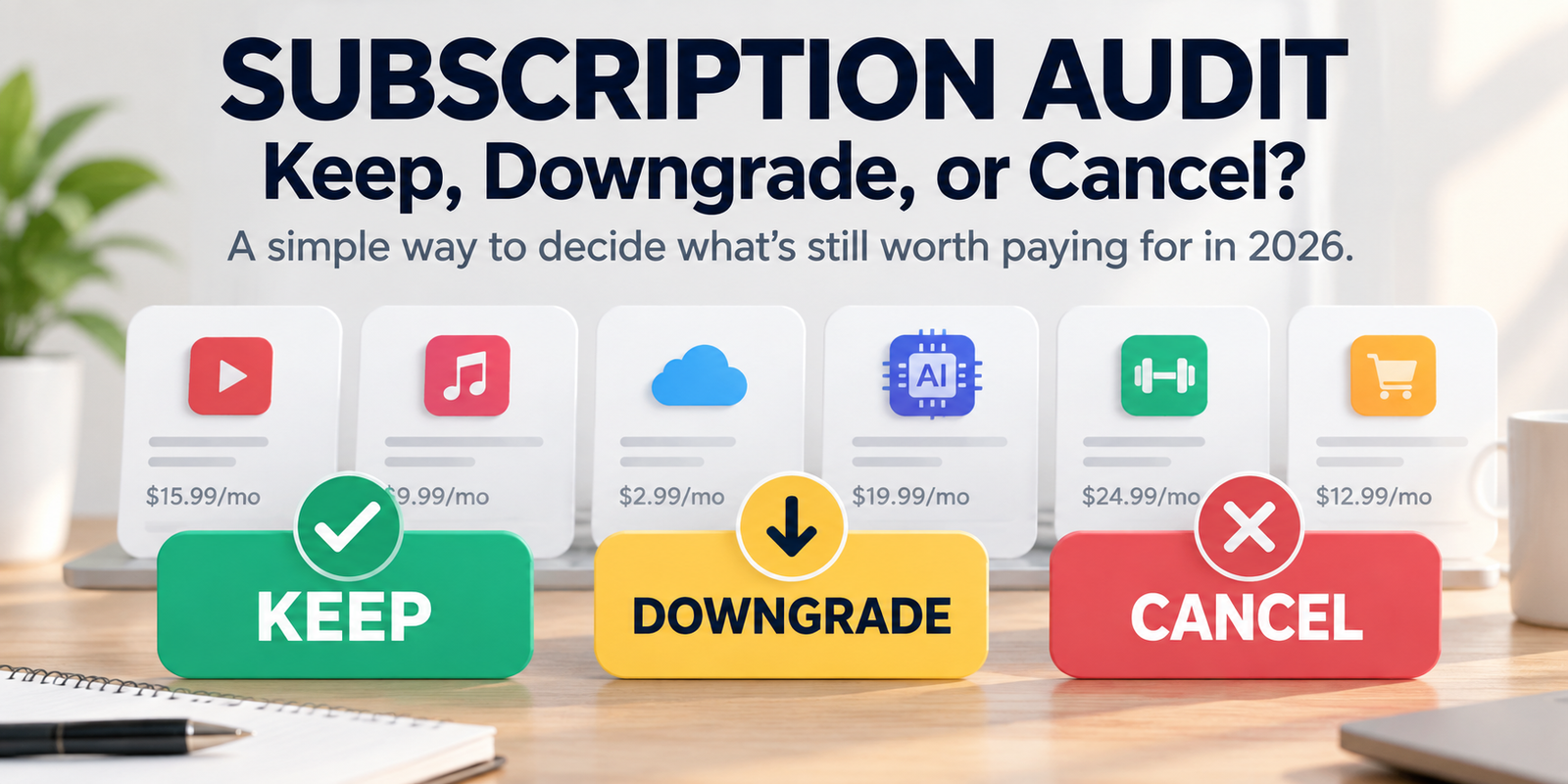
Are subscriptions worth it? They can be — but only when the value you get still justifies the recurring cost.
A $10 or $20 monthly subscription may not feel like a major expense. But when streaming, cloud storage, AI tools, apps, memberships, software, and other recurring charges pile up, the annual cost can be surprisingly high.
And the real problem isn’t necessarily having too many subscriptions.
It’s paying for subscriptions that no longer provide enough value to justify their cost.
A 2026 survey of 1,272 U.S. adults with paid subscriptions found that 59.9% had at least one subscription they hadn’t used in the previous 30 days. The average reported cost of those unused subscriptions was $26.79 per month — about $321 a year if that spending continued for 12 months.
So instead of automatically canceling everything, it may be more useful to ask a different question:
If you weren’t already subscribed, would you sign up again today at the current price?
Here’s a simple way to decide.
Quick Answer: Which Subscriptions Should You Cancel?
Consider canceling or downgrading a subscription if you rarely use it, its price has increased beyond the value you receive, a cheaper plan would meet your needs, or you wouldn’t subscribe again today at its current price.
Before canceling, check five things:
- Annual cost
- How often you actually use it
- Cost per use
- Whether a cheaper plan or alternative exists
- Whether you would subscribe again today
If a subscription still passes those tests, keeping it may make sense. If it doesn’t, consider downgrading, switching, pausing, or canceling it.
Why Small Monthly Subscriptions Become Expensive
Are subscriptions worth it when several small monthly charges start adding up? It depends on how much value you actually get from each one.
Subscription pricing makes expenses easy to underestimate.
Consider a service that costs:
$17.99 per month
That doesn’t sound like a major financial decision.
But over one year:
$17.99 × 12 = $215.88
Now imagine having five subscriptions around that price.
That’s roughly:
$1,079 per year.
The issue isn’t that spending $1,079 on subscriptions is automatically bad. If you use and value all of them, the expense may be completely reasonable.
The problem is paying $1,079 while regularly using only two or three of them.
That appears to happen frequently.
A 2026 Self Financial survey found that 59.9% of respondents with paid subscriptions reported having at least one unused subscription each month, with an average of 2.6 unused subscriptions among those affected.
Before deciding whether a subscription is cheap or expensive, convert the monthly price into an annual cost.
That changes the question from:
Is this worth $17.99?
to:
Would I intentionally spend $215.88 on this for the next year?
That’s a much more useful decision.
The 5-Minute Subscription Test
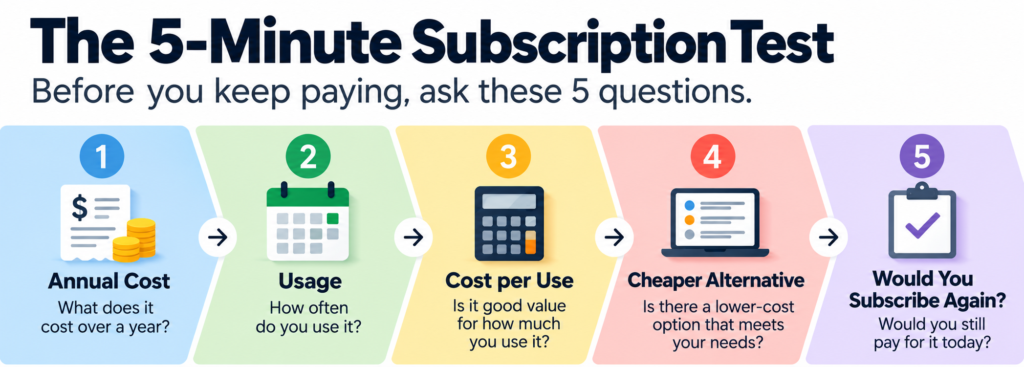
You don’t need a complicated spreadsheet to audit every recurring payment.
For each subscription, answer these five questions.
1. What Does It Actually Cost Per Year?
Start with the simplest calculation:
Monthly price × 12 = annual cost
For example:
| Monthly Price | Annual Cost |
|---|---|
| $5.99 | $71.88 |
| $9.99 | $119.88 |
| $14.99 | $179.88 |
| $19.99 | $239.88 |
| $29.99 | $359.88 |
| $49.99 | $599.88 |
This is especially useful for subscriptions that feel inexpensive because the charge is spread across 12 payments.
Don’t ask only:
“Can I afford $19.99 this month?”
Ask:
“Is this service worth $239.88 to me over a year?”
Those are different questions.
2. How Often Do You Actually Use It?
Next, look at actual usage — not how often you planned to use it when you subscribed.
Think about the last 30 to 90 days.
Did you use the service:
- Almost every day?
- Several times a week?
- Once or twice a month?
- Not at all?
A subscription you haven’t used recently isn’t automatically worthless. Some services — including travel-related tools, seasonal memberships, backup storage, or security products — may provide value even when you don’t actively use them every week.
But low usage should trigger the next question.
3. What Is Your Cost Per Use?
For subscriptions you actively use, calculate approximately what each use costs.
Suppose you pay:
$20 per month
and use the service:
2 times per month
Your approximate cost is:
$10 per use.
If you use it 20 times a month:
$1 per use.
Neither number automatically tells you whether to cancel.
But it makes comparison much easier.
For example, paying $10 per use for a fitness membership might still be worthwhile if the alternative costs $25 per visit.
Paying $10 per use for an entertainment service you barely care about may be different.
Cost per use gives you context. It doesn’t make the decision for you.
4. Is There a Cheaper Way to Get the Same Value?
Before hitting Cancel, check whether cancellation is actually your best option.
You may be able to:
Downgrade
Move from a premium plan to a basic or ad-supported tier.
Pause
Some memberships allow temporary pauses instead of full cancellation.
Switch
A competing service may provide what you actually use for less.
Use a free version
This can be especially relevant for software, cloud tools, productivity apps, and AI services.
If AI subscriptions are part of your monthly spending, start by comparing which AI tools are actually worth using for everyday productivity before paying for overlapping services.
Pay only when needed
If you use a service seasonally, subscribing for a few months and canceling afterward may cost less than maintaining it all year.
This is why a subscription audit shouldn’t simply be a cancellation exercise.
The goal is to find the lowest-cost option that still gives you what you actually need.
5. Would You Subscribe Again Today?
This may be the most useful question in the entire audit.
Imagine the subscription disappeared from your account tonight.
Tomorrow, you visit its website and see its current price.
Would you enter your credit card information and subscribe again?
If the answer is immediately yes, keeping it probably makes sense.
If your reaction is:
“Maybe.”
or:
“Probably not.”
then inertia may be doing more work than the service itself.
This matters because subscriptions can remain active long after the original reason for subscribing disappears.
Maybe you joined for one TV series.
Maybe you needed software for one project.
Maybe you signed up for a free trial.
Maybe you subscribed before the price increased.
The relevant question isn’t:
“Why did I subscribe?”
It’s:
“Would I buy this again today?”
Keep, Downgrade, Switch, or Cancel?
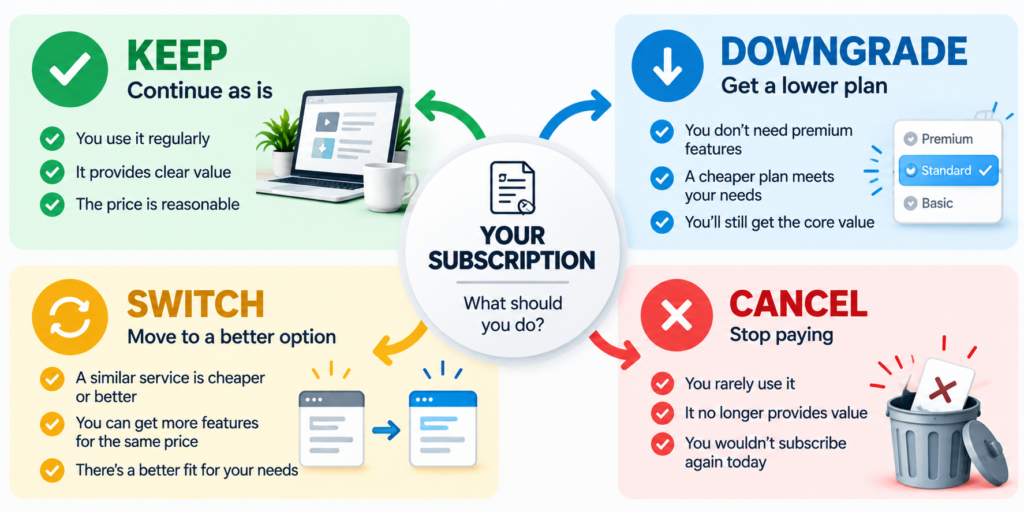
After the five questions, put each subscription into one of four buckets.
KEEP
Keep it when you:
- Use it regularly
- Would willingly subscribe again today
- Receive enough value for the price
- Don’t have a meaningfully cheaper alternative
There’s no reason to cancel a subscription simply because it is recurring.
A service you regularly use and value can be money well spent.
DOWNGRADE
Downgrade when:
- You use the service but not its premium features
- A cheaper tier provides most of what you need
- You’re paying for storage, users, features, or access you don’t use
This can be better than canceling because you preserve the useful part while reducing the recurring cost.
SWITCH
Switch when:
- You still need the service
- A competitor provides comparable value for less
- Your current plan has become expensive relative to alternatives
But don’t switch solely because another service advertises a lower monthly price.
Compare the features you actually use, cancellation terms, introductory pricing, and what the alternative will cost after any promotional period ends.
CANCEL
Cancellation makes the most sense when:
- You rarely or never use the service
- You wouldn’t sign up again today
- You forgot you were paying for it
- A free alternative meets your needs
- You’re keeping it only because canceling feels inconvenient
An unused $10 subscription isn’t just $10.
Keep it for another year and it becomes $120.
Don’t Cancel Based on Usage Alone
There’s an important exception to the cost-per-use rule.
Some subscriptions provide value because they’re available when you need them, not because you actively use them every day.
Cloud backup is one example.
Certain security services are another.
A VPN can also fall into this category for some travelers. You might barely use it at home but rely on it while traveling or using unfamiliar networks.
If a VPN is one of the subscriptions you’re reviewing, read our guide to whether you actually need a VPN for international travel before judging it only by the number of times you opened the app.
The same principle applies to any subscription whose value comes partly from protection, backup, convenience, or occasional access.
How to Find Subscriptions You Forgot About
Knowing what to cancel is only useful if you know what you’re paying for.
Start by checking:
Credit card statements
Review at least the last two or three months for recurring charges.
Bank statements
Some subscriptions may be charged directly to a checking account.
Apple subscriptions
On an iPhone, check the subscriptions associated with your Apple Account.
Google Play subscriptions
Android users should review recurring subscriptions through Google Play.
PayPal
Check automatic payments and recurring billing agreements.
Email
Search terms such as “subscription,” “renewal,” “receipt,” “membership,” and “trial.”
Don’t assume every recurring charge will contain the brand name you recognize. Billing descriptors can sometimes look different from the service name.
Do You Need a Subscription Tracking App?
Not necessarily.
If you have only a handful of subscriptions, reviewing your bank and credit card statements every few months may be enough.
But people with many recurring payments may prefer a subscription tracker.
For example, Rocket Money’s free tier currently includes recurring-subscription tracking, while its paid Premium service adds features including assistance canceling supported subscriptions. Rocket Money notes that some subscriptions still need to be canceled directly with the provider or billing platform.
If Narrowise later joins an appropriate affiliate program, the natural placement is immediately after the paragraph above.
Suggested future CTA:
Want all your recurring charges in one place? See how Rocket Money tracks subscriptions and what its free and paid plans include.
Until Narrowise has an approved relationship, keep this section informational and link only to the official source if desired.
More importantly, don’t create a new paid subscription just to save money on subscriptions without first checking whether the tool itself will provide enough value.
The same rule applies to the subscription manager.
How Often Should You Audit Your Subscriptions?
For most people, checking every subscription every three to six months is a reasonable starting point.
You should also review them when:
- A free trial is about to convert to paid
- A subscription raises its price
- An annual renewal is approaching
- Your usage changes
- You finish the project, trip, show, game, or other reason you originally subscribed
- You’re trying to reduce monthly expenses
A calendar reminder can prevent another year of paying for something you meant to cancel months ago.
A Simple Subscription Audit You Can Do Today
Open your latest credit card and bank statements.
Write down every recurring payment.
For each one, record:
Monthly cost → Annual cost → Usage → Cost per use → Alternative → Decision
For example:
| Subscription | Monthly | Annual | Usage | Decision |
|---|---|---|---|---|
| Service A | $15 | $180 | Daily | Keep |
| Service B | $20 | $240 | 1–2×/month | Downgrade |
| Service C | $10 | $120 | Never | Cancel |
| Service D | $25 | $300 | Weekly | Compare alternatives |
Don’t focus on canceling the largest number of subscriptions.
Focus on eliminating the spending that provides the least value.
The Bottom Line
So, are subscriptions worth it? A subscription isn’t a waste of money simply because it renews every month.
The better question is whether you would still choose to pay for it today.
For every subscription, check:
What does it cost per year?
How often do I use it?
What does each use effectively cost?
Is there a cheaper way to get the same value?
Would I subscribe again today?
Then choose:
Keep. Downgrade. Switch. Cancel.
The goal isn’t to spend nothing.
It’s to stop paying for things you no longer would have chosen to buy.
Frequently Asked Questions
How much money do people waste on unused subscriptions?
A 2026 survey of 1,272 U.S. adults with paid subscriptions found that 59.9% reported at least one subscription they hadn’t used in the previous 30 days. Among respondents with unused subscriptions, the reported average value was $26.79 per month, or about $321 over 12 months if that spending continued.
How do I know if a subscription is worth keeping?
Look at its annual cost, how often you use it, cost per use, available alternatives, and whether you would subscribe again today at the current price. Regular usage alone doesn’t necessarily make a subscription worthwhile, and infrequent usage doesn’t automatically make it wasteful. The question “Are subscriptions worth it?” is easier to answer when you compare what you actually use with what you pay.
Should I cancel subscriptions I don’t use every month?
Not automatically. Some subscriptions provide occasional, seasonal, backup, security, or convenience value. Compare the annual cost with the benefit you receive before canceling.
Is it better to cancel or downgrade a subscription?
If you still use the service but don’t need premium features, downgrading may preserve most of the value at a lower cost. Canceling makes more sense when you no longer need the service or wouldn’t subscribe again today.
How often should I review my subscriptions?
A review every three to six months is a practical starting point. It’s also worth reviewing subscriptions before annual renewals, after price increases, and when free trials are about to become paid plans.
Can subscription tracking apps cancel subscriptions for me?
Some can. For example, Rocket Money currently lets free users track recurring subscriptions, while its Premium tier can help cancel supported subscriptions. Some services still need to be canceled directly with the provider or billing platform. Rocket Money Help Center