Best Way to Book a Hotel in 2026: Expedia, Priceline, Booking.com, or Direct?

The best way to book a hotel isn’t always through the site showing the lowest price.The same hotel can appear on Expedia, Priceline, Booking.com, KAYAK, and the hotel’s own website — sometimes at different prices, with different cancellation rules and different perks.
So where should you actually book?
The short answer: Don’t choose a booking site first. Choose the hotel first, compare the same room across multiple booking options, and then book wherever the total value is best.
For many travelers, that means comparing prices across multiple travel sites first and then checking the hotel’s direct price before paying.
Here’s a simple way to do it.
The Best Way to Book a Hotel: The Quick Answer
There is no single booking method that is best for every trip.
Use a comparison site first if:
- You want to quickly compare prices across multiple travel sites.
- You haven’t decided where to book yet.
- Price is your main priority.
Consider Expedia, Priceline, or Booking.com if:
- The OTA price is meaningfully cheaper.
- You have member discounts with that platform.
- The cancellation terms are comparable to booking direct.
Consider booking directly with the hotel if:
- You have hotel loyalty status.
- You want to earn hotel points or elite-night credits.
- You value easier reservation management.
- The direct price is close to the OTA price.
The key is to compare the same room under the same conditions.
A $220 refundable room with breakfast may offer better value than a $200 non-refundable room without breakfast.
Step 1: Find the Hotel Before Choosing Where to Book
One common mistake is starting with a favorite booking site.
Instead, separate two decisions:
Which hotel do I want?
and
Where should I book that hotel?
They are not the same question.
A hotel search engine can help you compare many properties at once. Once you narrow your search to one or two hotels, compare the booking options for those specific properties.
Still deciding which hotel is actually worth the money? See our guide to choosing between a cheaper hotel and a better location.
KAYAK, for example, searches hotel prices across hundreds of travel sites and can show multiple booking options for the same property. It then redirects travelers to the selected provider to complete the reservation.
That makes a comparison tool useful at the research stage, even if you eventually book somewhere else.
Narrowise Tip
Search broadly → choose the hotel → compare where to book it.
You don’t need to manually open every booking website at the beginning.
Step 2: Compare the Real Price, Not Just the Lowest Number
Suppose the same hotel appears at these prices:
| Booking Option | Displayed Price |
|---|---|
| Expedia | $198 |
| Priceline | $204 |
| Booking.com | $195 |
| Hotel Direct | $210 |
Booking.com appears to be the obvious winner.
But before booking, check whether each offer includes the same:
- Room and bed type
- Taxes and mandatory fees
- Cancellation policy
- Breakfast
- Resort or destination fees
- Payment timing
- Member discounts
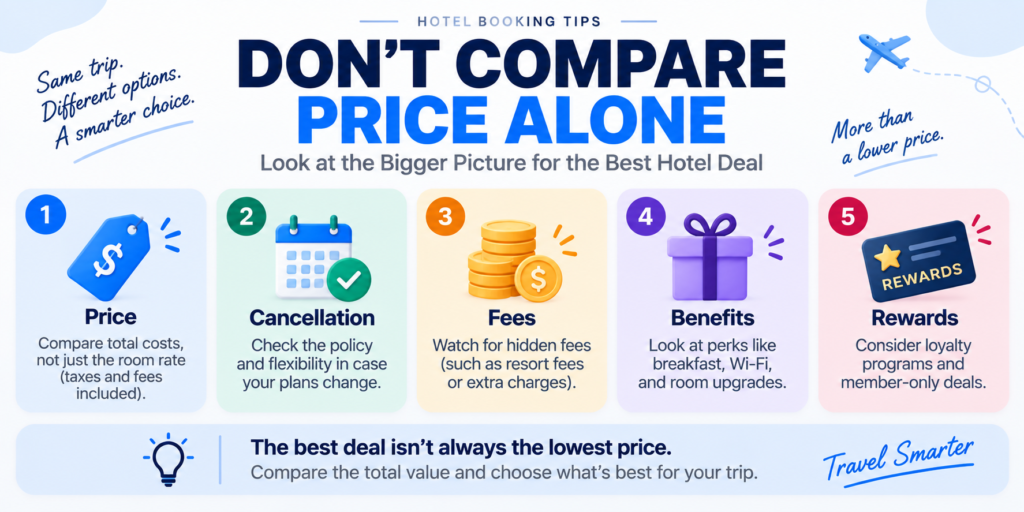
Even hotel price-match programs use this type of comparison. Hilton and Marriott, for example, require competing rates to have comparable booking conditions such as room type, dates and cancellation terms.
So don’t ask only:
“Which website shows the lowest price?”
Ask:
“Which option gives me the best total value for the same reservation?”
Step 3: Check Your OTA Member Discounts
The public price isn’t necessarily the price you will actually pay.
Major booking platforms have their own loyalty or member programs.
Booking.com: Its Genius program offers discounts on eligible properties. Genius Level 1 currently offers 10% discounts on participating stays, while higher levels can provide larger discounts and selected perks.
Expedia: One Key members can receive Member Prices on participating properties, including discounts of 10% or more on many eligible hotels.
Priceline: Priceline VIP offers hotel discounts and additional benefits that vary by membership level.
This means two travelers searching for the same hotel may see different effective prices depending on their accounts.
Always compare the logged-in price if you already use one of these programs.
Step 4: Check the Hotel’s Direct Price
After finding a good OTA rate, open the hotel’s official website and search the same dates and room type.
Booking direct can provide benefits that aren’t reflected in the displayed room price.
For example, Marriott says reservations made through third-party online travel channels such as Expedia, Priceline and Booking.com generally do not qualify for Marriott Bonvoy points, miles or membership-tier benefits.
Hilton similarly states that third-party reservations generally do not earn Hilton Honors Points, stay or night credits, or additional Hilton Honors benefits.
So imagine:
OTA: $195
Hotel Direct: $205
The OTA saves $10.
But if the direct reservation gives you hotel points, elite-night credit or other status benefits, paying an extra $10 could make sense.
On the other hand, if you don’t care about hotel loyalty benefits, the cheaper OTA price may be the better deal.
The important question is:
What am I giving up for the savings?
Step 5: Compare Flexibility Before Booking
A small price difference may not matter if your plans change.
Before choosing the cheapest option, check:
- Is the reservation refundable?
- Until when can you cancel?
- Do you pay now or at the hotel?
- Who handles changes or cancellations?
With some third-party reservations, you may need to contact the booking platform rather than the hotel to modify the reservation.
Hilton, for example, directs customers who booked through a third-party site to contact that third party to confirm, modify or cancel the booking.
That doesn’t mean third-party booking is bad.
It means flexibility has value too.
If your trip is certain and the savings are substantial, a cheaper restrictive rate might make sense.
If your plans could change, paying slightly more for a flexible reservation may be worth it.
Expedia vs Priceline vs Booking.com vs Direct: Which Is Best for You?
Instead of looking for one universal winner, start with your priority.
| Your Priority | Where to Start |
|---|---|
| Find the lowest available price | Compare multiple sites |
| Booking.com Genius discounts | Booking.com |
| Expedia One Key benefits | Expedia |
| Priceline VIP discounts | Priceline |
| Hotel points or elite status | Hotel Direct |
| Easier direct hotel relationship | Hotel Direct |
| Not sure | Compare first, then check direct |
The word start matters.
Even if one option looks best for your situation, check the final price and booking conditions before paying.
Where KAYAK Fits Into the Process
KAYAK is different from Expedia, Priceline and Booking.com in an important way.
KAYAK primarily functions as a travel search engine. It searches hotel prices across hundreds of travel sites, lets you compare available booking options, and then sends you to the provider you select to complete the reservation.
That makes it particularly useful before you decide where to book.
Instead of manually checking several websites one by one, you can compare available offers first and investigate the strongest options.
Compare Hotel Prices Across Multiple Sites
Search your destination and dates on KAYAK to compare hotel offers from multiple travel sites in one place.
Compare Hotel Prices on KAYAK →
Affiliate disclosure: Narrowise may earn a commission when you use some links on this page, at no additional cost to you.
One Important Warning About Comparison Sites
A comparison search should not necessarily be your final check.
Prices can change between search results and checkout, and no comparison tool necessarily includes every possible booking option.
Before paying:
Verify the final price and cancellation conditions with the booking provider.
And if hotel loyalty benefits matter to you, check the hotel’s official website too.
The 5-Minute Hotel Booking Method
You don’t need to search every travel website.
Use this process instead:
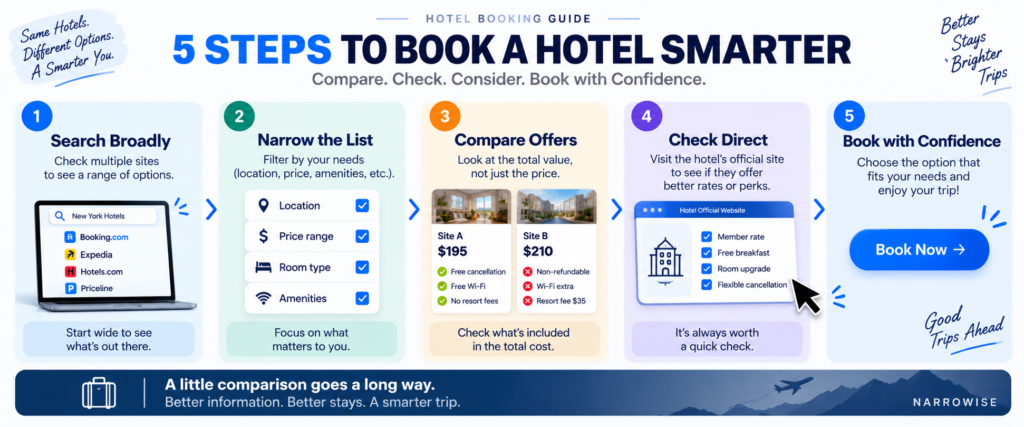
1. Search broadly
Find hotels that fit your destination, dates and budget.
2. Narrow the list
Choose one to three hotels you would actually stay at.
3. Compare current offers
Check available prices across multiple booking providers.
4. Check direct
Open the hotel’s official website and search the same room and dates.
5. Compare total value
Look at:
Final price + cancellation policy + included benefits + rewards + flexibility
Then book.
The goal isn’t to find a booking website that you use for every trip.
It’s to quickly find the booking option that makes the most sense for this trip.
FAQ
Is it cheaper to book a hotel directly or through Expedia?
Neither is always cheaper.
Expedia may offer Member Prices, while hotels can offer their own member rates and direct-booking benefits. Compare the same room, dates and cancellation conditions before deciding.
Is Booking.com cheaper than booking directly?
Sometimes.
Booking.com Genius can provide discounts on participating properties, while direct reservations may provide hotel loyalty points or benefits that third-party reservations do not.
Compare the total value, not just the room price.
Is Priceline cheaper than Expedia?
It depends on the hotel, dates and discounts available to your account.
Priceline VIP and Expedia One Key can both affect the price, so there is no universal winner.
Should I use KAYAK before booking a hotel?
It can be useful if you want to compare prices from multiple travel sites without searching each site individually.
Once you find a strong offer, verify the final price and conditions with the provider and check the hotel’s direct rate before paying.
Is booking a hotel directly better?
It can be, especially if you value hotel points, elite-status benefits or dealing directly with the hotel.
But if an OTA offers a substantially lower price with comparable conditions, the third-party booking may provide better value.
Bottom Line
Don’t automatically book with Expedia, Priceline, Booking.com — or the hotel itself.
Find the hotel you want first.
Then compare the same reservation across multiple booking options.
If an OTA is substantially cheaper and the conditions are comparable, it may make sense.
If the prices are close and you value hotel points, status benefits or direct reservation management, booking directly may be worth paying slightly more.
And if you don’t know where to start:
Compare first. Check direct. Then book.
Planning the rest of your trip? See how to use AI to find cheaper flights without booking a bad one.