
How to Tell If a Black Friday Deal Is Actually Good in 2026
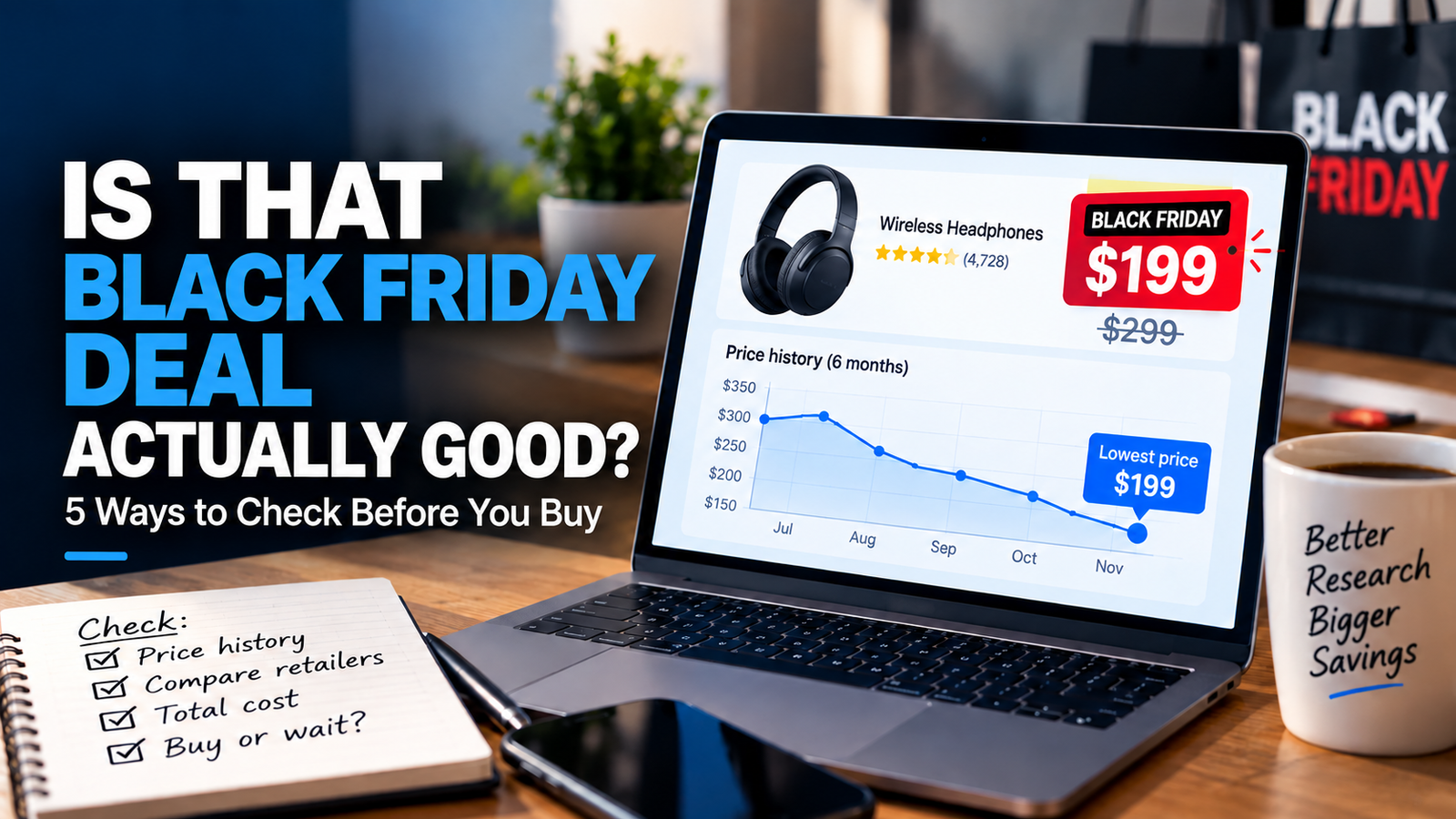
Black Friday is full of big discount labels. But “40% off” does not automatically mean you’re getting a good Black Friday deal.
The simplest way to tell if a Black Friday deal is actually good is to compare the sale price with the product’s recent price history—not just the advertised list price. Then compare the exact model across retailers and check the total cost, including shipping and any membership requirements.
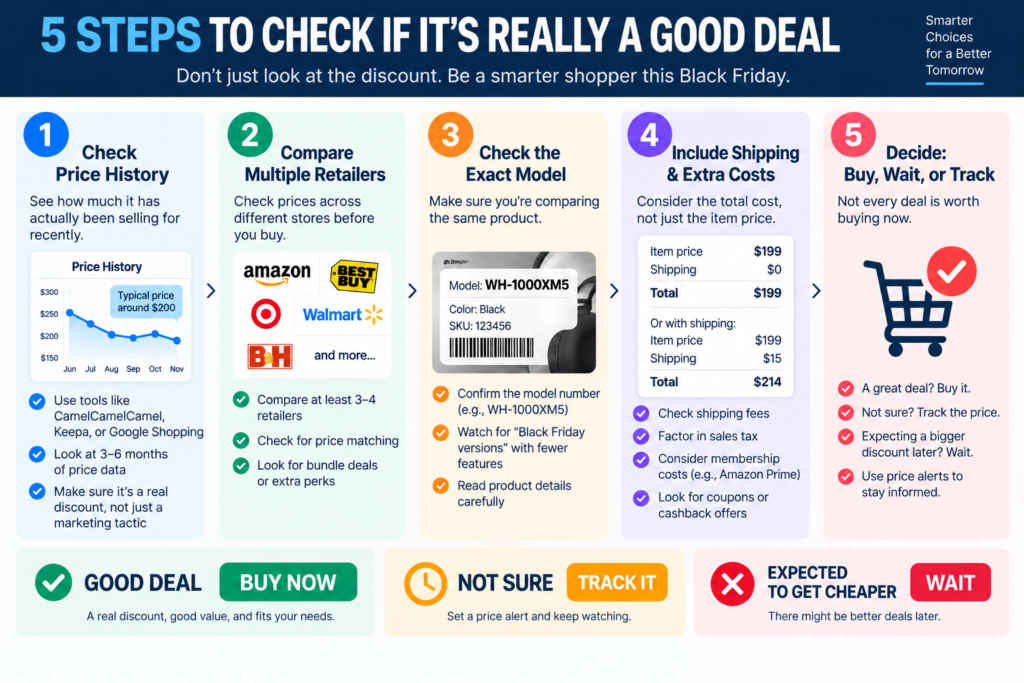
Here’s a simple five-step method.
1. Ignore the Percentage-Off Number at First
For example, imagine a retailer advertises:
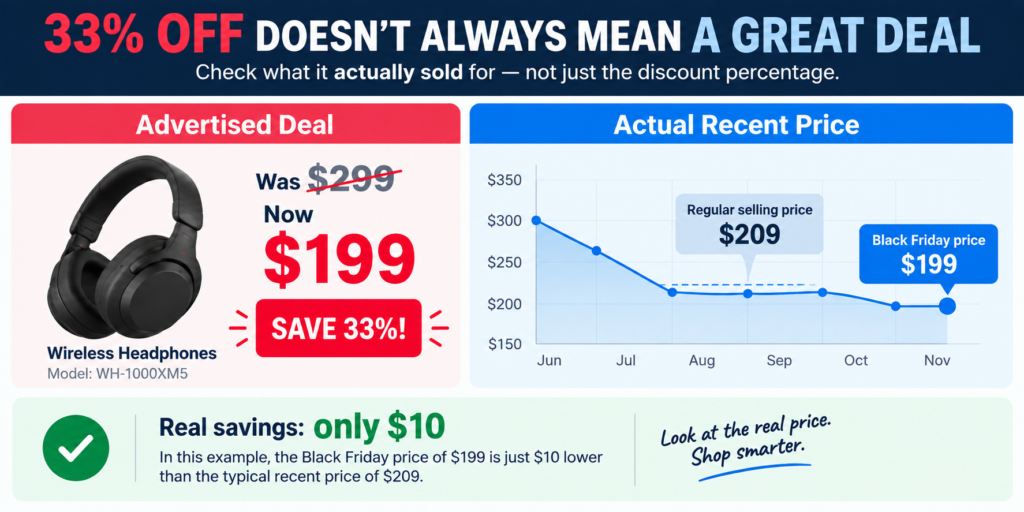
“Was $299 — Now $199 — Save 33%!”
That sounds impressive.
But the important question is not:
How much is it discounted from MSRP?
It is:
What has this product actually been selling for recently?
If it regularly sells for $209, a Black Friday price of $199 is only a modest deal.
Start with the current price—not the discount percentage.
2. Check the Price History
Before buying an expensive product, check whether today’s price is unusually low.
Google Shopping can show Price Insights, which indicates whether a price is low, typical, or high compared with recent prices. It can also identify products at a 30-day low.
Google also lets you track products and receive notifications when prices fall.
A simple rule:
| What You Find | What to Do |
|---|---|
| Near its normal price | Wait |
| Slightly below normal | Compare retailers |
| Near a recent low | Consider buying |
| Lowest price + you already need it | Strong reason to buy |
Price history is especially useful for electronics, appliances, TVs, headphones, and other products where prices change frequently.
3. Compare the Exact Product Across Retailers
Don’t stop after finding one good-looking price.
Search the exact model number at several retailers.
For example, compare:
Amazon → Walmart → eBay → manufacturer → other major retailers
Why the model number?
Retailers sometimes sell products that look nearly identical but have different specifications, storage capacity, accessories, or model years.
A $499 laptop isn’t cheaper than a $549 laptop if the cheaper version has half the storage.
Compare identical products whenever possible.
4. Calculate the Real Price
The lowest sticker price is not always the cheapest purchase.
Check:
- Shipping
- Membership requirements
- Return policy
- Warranty
- Seller reputation
- Included accessories
The FTC also recommends checking the complete product description, refund policies, shipping terms, and whether a seller offers price matching.
For example:
Store A: $189 + $20 shipping
Store B: $199 + free shipping
Store B is actually cheaper.
5. Decide: Buy, Wait, or Keep Tracking
You don’t need to find the absolute lowest price ever recorded.
You need to find a price that makes sense for you now.
BUY
Buy when the price is near a recent low, the exact product meets your needs, and competing retailers aren’t offering a meaningfully better total price.
WAIT
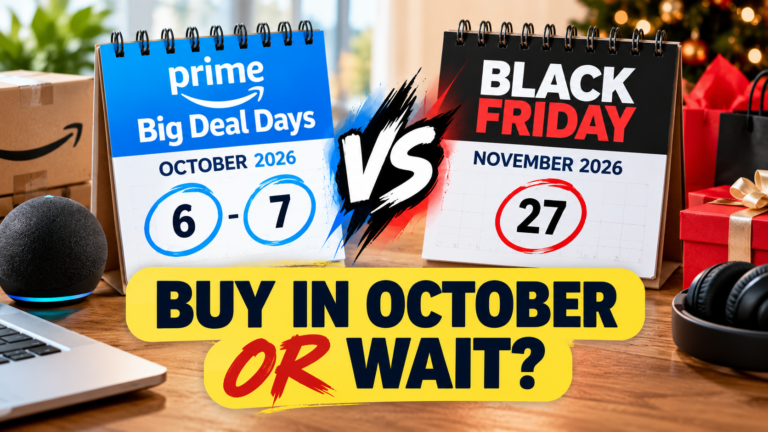
Wait when a Black Friday deal is based mostly on a high list price, the product has been cheaper recently, or Black Friday is still weeks away.
KEEP TRACKING
Track the price when it’s already attractive but you don’t need the product immediately.
Google’s price tracking can notify you if the price drops later.
Still deciding whether to buy now or wait? Read our guide to what to buy now, wait for, or start tracking before Black Friday.
Can AI Tell You If a Black Friday Deal Is Good?
AI can help, but it should not be your only source for current pricing.
AI is useful for comparing specifications, identifying alternatives, explaining model differences, and narrowing down which product fits your needs.
But current prices and inventory can change quickly.
A better workflow is:
AI → narrow the choices → price history → retailer comparison → buy or wait
This matters more than ever. Adobe reported that traffic from generative-AI tools to U.S. retail sites increased 693.4% during the 2025 holiday season, showing that shoppers are increasingly using AI during product research.
Are Black Friday Deals Actually Worth It?
Some certainly are.
During the 2025 holiday season, Adobe found that online discounts peaked at about 30.9% for electronics, 24.3% for TVs, 23.4% for computers, and 20.2% for appliances.
But category-wide discounts don’t tell you whether your specific product is a bargain.
That’s why price history matters.
Bottom Line
Don’t ask:
“How big is the discount?”
Ask:
“Is this price actually lower than what this product normally costs?”
For most Black Friday purchases, use this order:
1. Find the exact product
2. Check its price history
3. Compare the same model across retailers
4. Calculate the total cost
5. Buy, wait, or keep tracking
A big red “50% OFF” label is marketing.
The price history tells you whether you’re actually saving money.
Sources
Google Shopping — Price Insights & Price Tracking
Federal Trade Commission — Online Shopping Consumer Advice
Adobe Analytics — 2025 Holiday Shopping Season


6 Comments
Comments are closed.